


Two days before her daughter’s wedding this past June, Sharyn Hoppenheim accompanied her to the mikvah for her first immersion.
Years earlier, Hoppenheim had immersed herself for the first time, at age 50. Her daughter had been there to support her then.
“She had been part of my first experience,” Hoppenheim said. “And now, I was there to share hers. I realized that something had come full circle.”
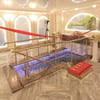
A month ago, that opportunity widened to the Laurentian Jewish community, as Mikvah Laurentian formally opened in a brand new building beside Congregation House of Israel in Sainte-Agathe-des-Monts, Quebec. The region’s first public mikvah designed to remain open year-round, the $2.5 million facility is located an hour’s drive from Montreal and includes separate mikvahs for women, men, and vessels.

Leading the effort was Rabbi Emanuel Carlebach, who has served as rabbi of the Orthodox congregation for 41 years, and his wife, Chani.
Thousands of Jewish families own cottages in the Laurentials or visit for weekends, holidays or summer vacations. While there are many seasonal synagogues in the mountainous area, House of Israel is the only one to keep its doors open on the long winter nights as well. But it did not have its own mikvah.
Seasonal mikvahs catering to the summer crowd would close their doors at the end of the season leaving locals with limited options.The Trout Lake mikvah, several miles away, operated out of a summer building, and Carlebach sometimes covered its winter expenses himself just to keep it open. When it was time for women to use the mikvah, they had a choice: travel to Montreal or try to arrange access to one of the existing facilities, which often meant long walks in the dark if a woman had to go on Shabbat.
The Carlebachs knew this had to change.

A Mikvah of Their Own
In 1975, the Rebbe, Rabbi Menachem M. Schneerson, of righteous memory, launched his mitzvah campaign focusing on family purity. At that time, mikvah observance was rarely discussed publicly, and many Jewish families were totally unfamiliar with this foundational mitzvah.
By placing it alongside core mitzvahs like Shabbat and kosher, the Rebbe signaled that family purity was not a marginal practice but a foundational pillar of Jewish life. He urged communities to build and beautify mikvahs immediately, insisting that they be attractive, clean spaces Jewish women would feel proud to use.
The effort to bring a mikvah to the Laurentians took more than 20 years.
An early attempt to purchase property for a mikvah fell through, and the city later rejected plans to incorporate one into a synagogue renovation. Eventually, Carlebach was told that he would need to pursue the project independently.
Groundbreaking took place three years before this summer’s opening. Sam and Naomi Fayer provided the first major gift; Mikvah USA and other benefactors later supplied substantial additional support. The final project cost was approximately $2.5 million.

‘We Feel Very Blessed’
Hoppenheim’s family has kept a vacation home in the Laurentians throughout her life, and it has been a constant of her Jewish life. Her brother celebrated his bar mitzvah at House of Israel, and the family regularly attended the congregation’s annual Shabbat on the Lake.
Yet she knew little about ritual immersion. A mikvah tour before her daughter’s bat mitzvah opened a longer conversation about bringing more Jewish observance into everyday life. Her connection to the House of Israel congregation deepened through her daughter and son-in-law, as well as her family’s support of the mikvah campaign.
In the weeks before the opening, Carlebach’s wife, Chani, taught Hoppenheim about the new mikvah and walked her through the facility. With a women’s mikvah and a mikvah for dishes and utensils now nearby, Hoppenheim said observance can be woven into ordinary family life for Laurentian Jews rather than requiring a separate trip.
“For me, the mikvah has become so deeply connected to my relationship with my daughter,” she said, “and to the traditions we are continuing to build as a family.”
For Carlebach, completing the project after four decades in the region evoked a deep feeling of gratitude.
“We feel very blessed, very, very fortunate,” he said. “There’s so much simcha, there’s so much joy.”
Hoppenheim is already looking beyond the opening to the women and families who will use the facility in the years ahead.
“Having this here means that Jewish life can become a more natural part of our everyday routines,” she said. “It creates a place where traditions can be practiced, shared between generations, and passed on to our children and grandchildren.”






Wow, kol hakavod to chabad for spreading kedusha and tahara!